A new inquiry arrives at 11:47 p.m. The couple asks whether a September Saturday is available, whether outside catering is allowed, and how many guests the ballroom can hold. By morning, your sales lead is juggling tours, staffing, and a full inbox. The couple is comparing venues and reading silence as a signal.
A better inquiry experience is more than a fast reply. It is a clear path from first message to useful answer to scheduled tour. The venue should sound welcoming, provide reliable information, ask the next sensible question, and make a visit easy to book. That path can be designed as an operating system rather than left to individual memory.
Treat the first reply as the beginning of a journey
Many venue teams optimize the first response as if it were a standalone email. Couples experience it differently. They are trying to decide whether your venue understands their date, guest count, priorities, and style. A generic “Thanks for reaching out—here is our brochure” makes them do the work of translating information into a decision.
Start with four jobs for the first response:
- Acknowledge the occasion. Use the couple’s names when available and reflect what they shared.
- Answer the immediate question. Confirm availability or explain that a date needs review; answer capacity and policy questions from approved venue information.
- Qualify gently. Ask only for details that change the next recommendation, such as event date, estimated guest count, ceremony needs, or preferred tour timing.
- Offer a next step. Give two or three realistic tour windows instead of asking an open-ended “When are you free?”
This structure keeps the conversation human and gives your team a repeatable review standard.
Alpha Venue’s platform describes Ella as an AI sales, planning, and support assistant trained on a venue’s pricing, packages, policies, availability, FAQs, workflows, floor plans, and brand voice. That product-specific detail matters: a useful first answer depends on venue knowledge, not a generic script. Configuration still matters, and the venue remains responsible for defining the rules and the path to human review.
Build a response that earns the tour
The goal is to make a tour the logical way to answer the couple’s remaining questions.
A practical response sequence looks like this:
Warm opening: “Thanks for sharing that you’re planning a September wedding for about 150 guests.”
Direct answer: “The ballroom’s published capacity and the current availability for your preferred date are…”
Useful context: “For your guest count, the room can support a seated dinner and dance floor. Our catering policy is…”
One clarifying question: “Are you envisioning your ceremony on site as well?”
Tour invitation: “I can show you the ceremony options and reception layout. Would Saturday at 10 a.m., Sunday at 1 p.m., or Wednesday at 5 p.m. work?”
This is a template, not a script to send without judgment. If availability is not confirmed, say so. If a policy has an exception, route it for approved review. If the couple asks for a person, make the handoff visible rather than pretending an automated answer is final.
The best inquiry workflow also records why the couple is visiting. “Interested in ballroom” is less useful than “150 guests, ceremony on site, asks about outside catering.” That context helps the host prepare the right floor plan, policy answer, and tour route.
Make follow-up feel like service, not pressure
Most teams know follow-up is important. The operational problem is that follow-up often depends on a person remembering which lead needs attention and what was already discussed. A better sequence changes the message as the couple moves closer to a decision.
Immediately: confirm the conversation and provide the promised answer or link.
After a short pause: offer tour times again, with a reason to visit tied to the couple’s stated priorities.
After the tour is booked: send a concise confirmation with time, arrival instructions, parking details, expected duration, and the names of the people they will meet.
Before the tour: send a reminder that makes the visit feel prepared, not transactional. Invite the couple to bring questions about layout, catering, timing, or rain plans.
After the tour: recap the choices discussed, identify any open question, and state the next step. If a proposal or agreement is appropriate, explain what it contains and who will review it.
Language should stay warm and specific. “Just checking in” says nothing about the couple’s decision. “You mentioned wanting dinner and dancing in one room; during Saturday’s visit we can compare the two layouts and walk through the transition between ceremony and reception” gives the follow-up a purpose.
Design the tour around decisions, not a room inventory
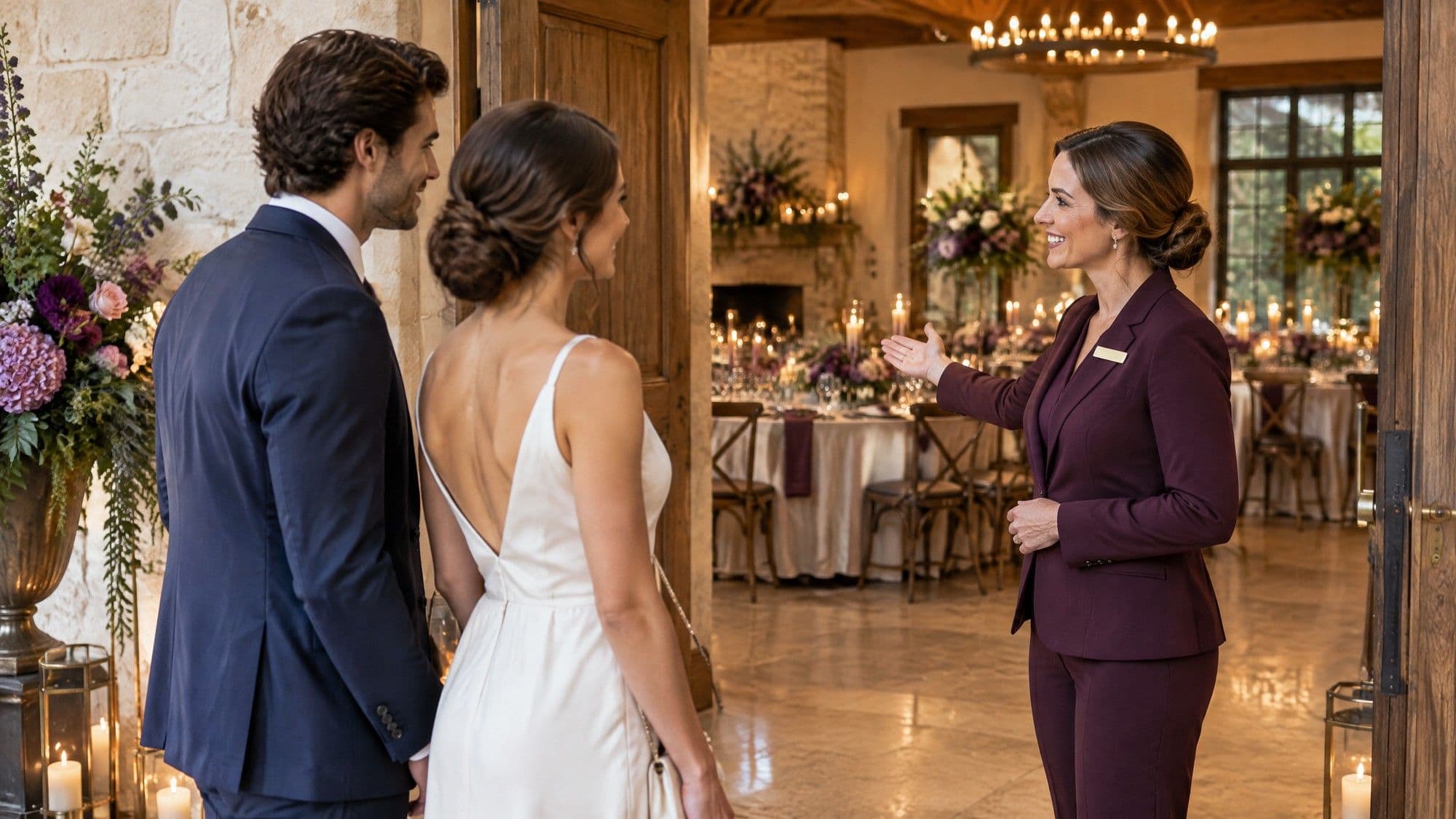
A tour is not a parade past attractive spaces. It is a guided decision session. Before the visit, assemble the information that makes the experience coherent: date status, guest count, ceremony preference, catering questions, accessibility needs, and the couple’s stated priorities.
Use a simple tour plan:
- Welcome: restate what brought the couple in and confirm the visit’s goals.
- Route: show the spaces in the order the event will use them, from arrival through departure.
- Proof: connect each space to a practical question: guest flow, weather backup, vendor access, sound, setup time, or privacy.
- Pause: ask what feels right and what still feels uncertain.
- Next step: explain the decision timeline, proposal process, and human contact for follow-up.
This approach lets the venue demonstrate hospitality and operational competence at the same time. It also prevents the host from overloading the couple with every package detail before they understand how the day could work.
Alpha Venue’s platform says it can schedule tours and meetings, support proposals and contracts, and keep venue teams informed through handoffs. Its separate process page describes designing the agent, training and configuring it, then launching, testing, and optimizing it. For an owner, the takeaway is not that automation replaces the tour host. It is that the pre-tour work can be structured so the host receives a prepared conversation rather than a blank calendar entry.
Give staff a clear handoff standard
A seamless experience needs a boundary between automation and staff judgment. Define what Ella may answer from approved knowledge, what requires a draft for review, and what must go directly to a person. The exact boundary will depend on your venue’s policies, systems, and configuration.
At minimum, a handoff should include the full conversation, the couple’s date and guest estimate, the questions still open, and the promised response time. Staff should not have to ask the couple to repeat the story that brought them to the venue.
Review a small sample of conversations each week. Look for unanswered questions, overly long replies, incorrect assumptions, missing tour details, and follow-ups that do not reflect the couple’s priorities. Then update the knowledge or workflow that caused the issue. Testing before launch and ongoing refinement are part of the experience, not a one-time technical exercise.
A short implementation checklist
Use this checklist in a team meeting:
- What information must be confirmed before we say a date is available?
- Which three questions most often determine the right tour route?
- Which tour slots can we reliably offer across channels?
- What should a couple receive immediately after booking?
- Which topics require approved human review?
- What must the host know before opening the door?
- How will we review conversations and correct the workflow?
A strong answer to these questions becomes a service standard. It can guide a coordinator, a sales lead, or a configured AI assistant without changing the venue’s voice.
Turn a better first impression into a better operating rhythm
The first inquiry and the venue tour are not separate marketing moments. They are connected parts of the same promise: we heard you, we can answer clearly, and we are prepared to help you imagine the day here.
Alpha Venue’s full demo specifically covers venue goals, Ella responding to venue-specific questions and booking tours, the venue’s rules and voice, the tour-to-booking workflow, planning conversations, and costs and ROI. If you are evaluating a more consistent inquiry process, schedule a demo with Alpha Venue and bring one real inquiry path, one tour calendar, and the policies your team answers most often. The useful question is not whether automation sounds impressive. It is whether the configured experience helps your team welcome the right couple with the right context at the right time.